
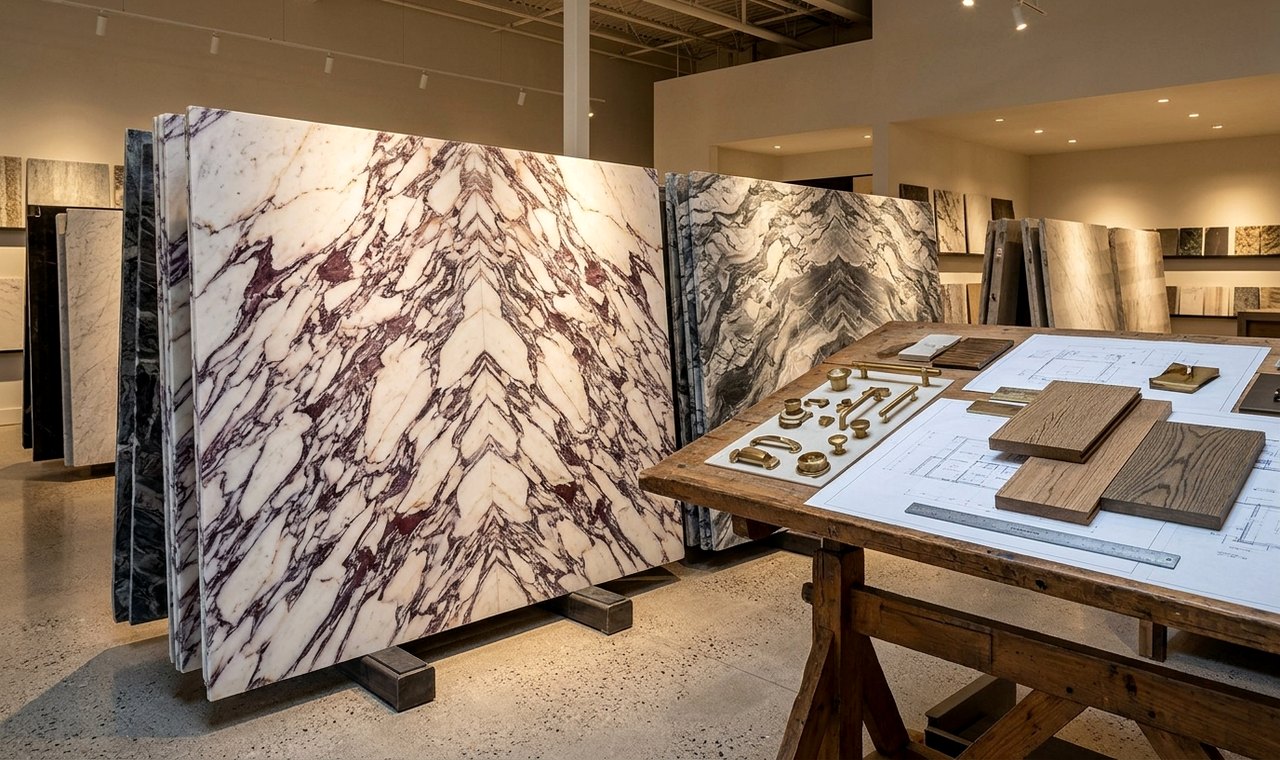
The Architect's Guide to Selecting Book-Matched Stone Slabs for Luxury Kitchens
- Always reserve sequential slab numbers from the same quarry bundle for continuous vein matching.
- Choose honed or satin finishes over high-gloss polished marble to disguise micro-etching gracefully.
- Pair a dramatic marble show island with a durable quartzite or stainless scullery worktop.
When commissioning a bespoke culinary space in the $200,000 to $500,000+ tier, no single material decision carries more visual weight than the selection and fabrication of natural stone. Yet many homeowners are guided only by small showroom samples rather than inspecting sequential quarry blocks in person.
1. Inspecting Sequential Quarry Bundles for True Book-Matching
True architectural book-matching requires reserving consecutive slabs cut from the exact same quarry block—polished or honed on opposite faces so their geological veining mirrors symmetrically across a waterfall island edge or full-height backsplash.
2. Quartzite vs. Calacatta Marble: Performance in Working Kitchens
For show kitchens where sculptural drama is paramount, Italian marbles such as Calacatta Viola, Calacatta Borghini, and Arabescato Corchia remain unmatched when finished in an acid-resistant honed patina and protected with breathable fluorochemical penetrating sealers. For heavy daily culinary zones and concealed sculleries, crystalline quartzites like Taj Mahal or Perla Venata offer Mohs hardness ratings of 7—impervious to citrus etching and thermal shock.
3. Mitered Apron Engineering & Structural Aluminum Honeycomb
To achieve a monolithic 2.5-inch or 3-inch stone island profile without excessive dead weight on drawer glides, we CNC-miter 2cm slabs at 45.5 degrees, reinforce the interior core with aerospace-grade aluminum honeycomb backing, and tint epoxy resins to the exact spectrophotometric hue of the stone matrix.